
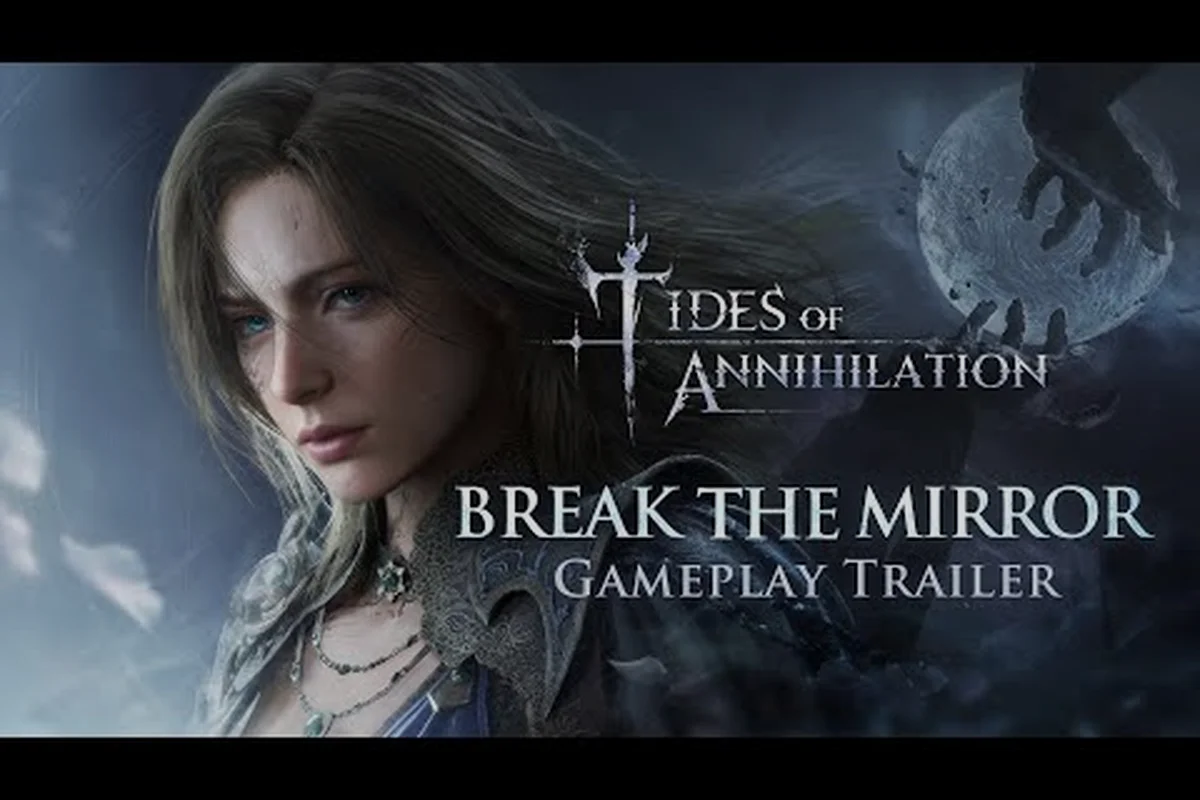
The Tides of Annihilation story trailer breakdown reveals far more than flashy combat — it layers Arthurian myth onto a shattered modern London, and the details hidden in those frames reshape how we understand the entire narrative. This analysis walks through the reveal trailer frame by frame, decoding the bridge between worlds mechanic, the medieval echoes setting, and the character beats that define Gwendolyn's quest. Whether you caught the trailer during State of Play or are just hearing about it now, understanding these story beats matters because they establish the stakes before you ever touch the controller.
The reveal trailer, published on the PlayStation channel and the official Tides of Annihilation YouTube channel, opens with a London skyline that feels both familiar and wrong — landmarks stand half-collapsed while a colossal knight strides through the fog. That visual shorthand tells you everything: this is not a medieval fantasy world, but a modern city invaded by something ancient. The game's official website describes Gwendolyn as a lone survivor fighting alongside spectral Knights of the Round Table, and the trailer reinforces that premise through every environmental detail, from crumbling Big Ben to the ethereal blue glow of her summoned allies.
Decoding the Bridge Between Worlds in the Reveal Trailer
The bridge between worlds concept is the single most important narrative device introduced in the Tides of Annihilation reveal trailer, and it operates on two distinct levels that players should understand before the game launches. On the surface, the bridge refers to the literal connection between modern London and the mythical realm of Avalon — the trailer shows massive portals tearing through the cityscape, with Arthurian architecture bleeding into contemporary streets. But the deeper meaning, which the trailer hints at through visual storytelling rather than dialogue, is that Gwendolyn herself functions as the bridge. She carries the bloodline of Avalon while living in the modern world, making her the only character who can navigate both realms without being destroyed by either.
The trailer's opening sequence establishes this duality through a series of quick cuts that reward careful viewing. We see Gwendolyn walking through a rain-soaked London street, then the frame shifts to her standing in a torch-lit hall that could be straight out of Camelot, then back to London again. These transitions happen without any visible loading or teleportation effect, suggesting the two worlds exist in the same physical space — layered on top of each other like overlapping realities. According to community analysis of the trailer, this interpretation aligns with the game's title, where "tides" represent the ebb and flow between these two coexisting dimensions.
How the Trailer Establishes the Avalon-London Connection
The medieval echoes setting becomes immediately apparent when you compare the trailer's two visual palettes. London scenes use muted grays, blues, and browns — realistic urban tones that ground the setting in contemporary reality. Avalon sequences, by contrast, burst with gold, emerald, and deep purple, signaling that this realm operates by different rules. The trailer deliberately avoids showing a clean transition between these spaces, which suggests the bridge between worlds is not a physical portal but a state of being. Gwendolyn doesn't travel to Avalon; she perceives it, and the trailer implies that perception shifts based on her emotional state or the presence of the spectral knights.
This reading gains support from the way the trailer frames the Knights of the Round Table. They appear as translucent blue figures that overlay the modern environment rather than replacing it — you can see London landmarks through their bodies. That visual choice communicates that these knights exist in a different frequency of reality, and Gwendolyn's unique heritage allows her to interact with them. The official Steam page confirms this interpretation, describing Gwendolyn as fighting "alongside spectral Knights of the Round Table against hordes of enemies across a shattered London," which positions the knights as coexisting with rather than replacing the modern setting.
The Fog as a Narrative Device in the Trailer
One of the most overlooked elements in the Tides of Annihilation story trailer breakdown is the recurring fog that rolls through nearly every scene. The trailer uses fog not as atmospheric decoration but as a boundary marker — where the fog thickens, Avalon bleeds through; where it thins, London reasserts itself. This visual motif connects directly to the game's invasion lore, which describes an otherworldly force consuming the city. The fog functions as the visible edge of that invasion, and the trailer's most dramatic moments occur when characters stand at that boundary line.
The trailer also uses the fog to obscure and reveal in equal measure. During the combat sequences, enemies emerge from the mist with little warning, creating a sense of constant threat that matches the game's survival horror undertones. But the fog also hides narrative details — careful viewers have spotted silhouettes in the background that the trailer never fully reveals, leading to speculation about hidden characters and future story beats. This deliberate obscuring technique suggests the developers are holding back significant lore reveals for the full game, and the trailer's fog is both a literal and metaphorical representation of that secrecy.
Story Depth Analysis: What the Trailer Reveals About Gwendolyn
The story depth analysis of the reveal trailer centers on Gwendolyn's characterization, and the trailer is remarkably efficient at establishing her emotional core without a single line of dialogue. We see her grieving over a fallen figure, we see her rage during combat, and we see her determination as she walks toward an enormous castle that materializes in the London skyline. These three emotional beats — grief, anger, resolve — map directly onto the game's stated narrative of saving her sister and seeking vengeance on the demi-gods of Avalon.
The trailer's most telling moment comes in a brief shot where Gwendolyn touches a wall and the camera lingers on her hand. The wall shows faint carvings that match Arthurian iconography, and her touch triggers a golden glow that spreads across the stone. This single gesture communicates that Gwendolyn has a connection to Avalon that predates the invasion — she is not a random survivor but someone with a destiny tied to the mythical realm. The trailer never explains this connection, but the visual language strongly implies a bloodline link to Arthur's legacy, which aligns with the game's Arthurian inspiration documented on the Wikipedia page for Tides of Annihilation.
Gwendolyn's Motivation as Shown in the Trailer
The trailer establishes Gwendolyn's motivation through a sequence that intercuts her combat with flashbacks of a woman — presumably her sister — being taken by shadowy figures. These flashbacks appear in a different visual style, using warmer colors and softer focus, which separates them from the harsh reality of the present. This stylistic choice tells players that Gwendolyn's past drives her present actions, and the rescue of her sister is the emotional engine behind every battle shown in the trailer.
What makes this story depth analysis particularly interesting is what the trailer leaves out. We never see Gwendolyn's sister's face clearly, we never hear the demi-gods speak, and we never learn why Avalon invaded London. These omissions are intentional — they create narrative gaps that the full game will fill, and they give players a reason to invest in the story rather than treating it as window dressing for combat. The trailer positions Gwendolyn as a character with agency and depth, not just a vessel for gameplay mechanics.
The Knights of the Round Table as Character Foils
The spectral knights shown in the trailer serve a dual narrative purpose that enriches the world building explained through visual storytelling. First, they function as gameplay companions — the trailer shows Gwendolyn summoning them for coordinated attacks, which matches the Dual Frontline Battle System described on the official website. Second, they act as character foils, representing the ideals of Arthurian chivalry that Gwendolyn must reconcile with her quest for vengeance. The trailer hints at this tension by showing moments where the knights appear hesitant or conflicted during her more brutal combat maneuvers.
This character dynamic suggests the game will explore whether Gwendolyn's revenge aligns with or contradicts the values of the knights she fights alongside. The trailer's final shot — Gwendolyn standing before a massive castle with the knights arrayed behind her — frames her as their leader, but the expression on her face reads more like burden than triumph. That ambiguity is the trailer's strongest storytelling choice, and it sets up a narrative that could go in multiple directions when the full game releases.
Medieval Echoes Setting: How the Trailer Blends Two Eras
The medieval echoes setting is the trailer's most visually striking achievement, and the world building explained through its art direction deserves close attention. The trailer shows London landmarks — Tower Bridge, the Houses of Parliament, the London Eye — in various states of ruin, with Arthurian structures growing through and around them like organic matter. Castles sprout from office buildings, siege weapons sit in Trafalgar Square, and the Thames runs with an unnatural golden glow. This visual fusion creates a setting that feels neither purely modern nor purely medieval, but something entirely new.
The trailer's color grading reinforces this fusion. Modern elements appear desaturated and cold, while Avalon elements burn with warm, saturated light. This contrast creates a visual hierarchy that tells players which elements are native to each world, and the way these palettes bleed into each other during the trailer's action sequences suggests the boundary between eras is breaking down. By the trailer's end, the two palettes have nearly merged, visually communicating that the invasion has reached a critical stage where London and Avalon are becoming one continuous space.
Environmental Storytelling in the Trailer's Set Pieces
Each major set piece in the trailer contributes to the medieval echoes setting through environmental storytelling that rewards multiple viewings. The opening shot of a knight's sword embedded in a London street, surrounded by shattered glass and modern debris, establishes the invasion's violence in a single image. Later, a brief shot shows a round table — the actual Round Table — floating in the Thames, its surface glowing with Arthurian runes. These details are easy to miss on first viewing, but they build a coherent world where two histories have collided.
The trailer also uses architecture to tell story. Avalon structures in the trailer are built from stone and gold, but they incorporate modern materials — steel beams, glass panels, concrete — suggesting the invasion is not a clean replacement but a corruption. This visual choice implies that Avalon's arrival has fundamentally altered London's physical reality, and the bridge between worlds is not a pathway but a merging. The world building explained through these environmental details gives players a richer understanding of the game's stakes than any dialogue could.
The Colossal Knights as Setting Elements
The colossal knights that dominate the trailer's skyline function as more than bosses — they are walking monuments that define the medieval echoes setting. Each giant knight in the trailer has a distinct design that references different aspects of Arthurian legend, from the armor styles to the heraldic symbols emblazoned on their shields. The trailer shows three distinct colossal knights, and their designs suggest they represent different factions or regions of Avalon, hinting at a complex political structure within the invading realm.
These giants also serve a practical narrative purpose in the trailer: they establish scale. By placing these enormous figures against recognizable London landmarks, the trailer communicates the overwhelming nature of the invasion. Gwendolyn appears tiny by comparison, yet the trailer shows her standing her ground against them, which immediately establishes her as a character of extraordinary capability. The story depth analysis of these scenes reveals that the game is not about surviving the invasion but about confronting it head-on, which aligns with the game's action-oriented combat design.
Trailer Clues, Lore and Foreshadowing
The reveal trailer lore contains numerous hidden details that reward careful viewing, and cataloging them provides a richer understanding of the game's narrative ambitions. One of the most discussed details among the community is a brief shot of a grail-shaped object glowing in a London underground station — a direct reference to the Holy Grail that the game's plot centers on. Another frame shows a mural depicting Arthur and Mordred locked in combat, which foreshadows the game's civil war narrative within Avalon.
The trailer also contains several audio cues that function as narrative breadcrumbs. A faint choir can be heard during the Avalon sequences, singing in what sounds like Old English, while the London scenes use ambient city sounds — traffic, rain, distant sirens. This audio contrast reinforces the bridge between worlds concept, and the way the two soundscapes begin to overlap during the trailer's climax suggests the merging of realities is accelerating.
Symbolism in the Trailer's Color and Light
The reveal trailer lore uses color symbolism extensively, and understanding this visual language enhances the story depth analysis. Gold appears throughout the trailer as the color of Avalon's power — it glows from the knights, radiates from the grail, and illuminates the invading structures. Blue, by contrast, represents Gwendolyn's connection to the knights, appearing in her summoned allies and in the energy she channels during combat. The trailer's most dramatic moment occurs when these two colors merge during a final attack sequence, suggesting Gwendolyn is learning to harness Avalon's power rather than merely fighting against it.
Red appears sparingly in the trailer, but always in moments of violence or emotional intensity — a splash of blood, a glowing wound, the eyes of an enemy. This limited use makes red more impactful when it appears, and it creates a visual hierarchy that guides player attention. The world building explained through this color system gives the trailer a coherence that rewards attentive viewing, and it suggests the full game will use similar visual language to communicate narrative information.
What the Trailer Doesn't Show: Narrative Gaps
Part of the reveal trailer lore is what remains unseen, and the trailer's omissions are as telling as its revelations. We never see Mordred, despite the Arthurian civil war being a central plot element. We never see Avalon itself — only its structures and inhabitants bleeding into London. And we never learn why the demi-gods invaded, what they want, or whether Gwendolyn's quest for vengeance aligns with or opposes their goals. These gaps are deliberate, and they position the trailer as a prologue rather than a summary.
The trailer also avoids showing any other human characters besides Gwendolyn and her sister. London appears empty of survivors, which raises questions about the invasion's toll and whether Gwendolyn is truly alone. This absence creates narrative tension — if Gwendolyn is the only survivor, her quest takes on additional weight; if others exist, the game may feature ally or NPC systems not shown in the trailer. The story depth analysis of these gaps suggests the developers are keeping significant narrative systems under wraps until closer to launch.
World Building Explained: The Trailer's Narrative Architecture
The world building explained through the reveal trailer establishes a coherent narrative architecture that supports both the game's story and its gameplay systems. The bridge between worlds concept provides a framework for the Dual Frontline Battle System, where Gwendolyn summons knights for combat — the knights are literally bridging the gap between Avalon and London. The medieval echoes setting justifies the game's enemy variety, from Arthurian knights to modern-infused monstrosities. And the invasion narrative creates stakes that make every combat encounter meaningful beyond mere gameplay.
The trailer's narrative architecture also establishes the game's thematic concerns. Gwendolyn's quest for vengeance against the demi-gods positions her as a figure challenging divine authority, which echoes Arthurian themes of mortal ambition confronting supernatural power. The trailer's visual language — the merging of modern and medieval, the fog as boundary, the color symbolism — all reinforce this thematic framework. According to the game's official website, the story explores saving family and restoring a broken world, and the trailer's story depth analysis confirms these themes are central rather than peripheral. This narrative focus is reinforced by the game's symbolic use of London as a stage, and for a deeper look at how the city's landmarks and weather patterns mirror the protagonist's internal conflict, see our Tides Of Annihilation Typhoon Of London Meaning analysis.
How the Trailer Sets Up the Game's Story Structure
The reveal trailer's structure mirrors what players can expect from the full game's narrative. It opens with establishing the world, moves to character introduction, escalates through combat sequences, and ends with a promise of larger conflicts to come. This structure suggests the game will follow a similar arc, with early chapters focused on survival and understanding the invasion, mid-game chapters exploring Avalon's politics and the demi-gods' motivations, and late-game chapters delivering the vengeance and restoration the plot promises.
The trailer also establishes a rhythm between story and combat that the game will likely replicate. Quiet character moments — Gwendolyn touching the wall, grieving over her sister — alternate with explosive action sequences. This alternation is a common action-game structure, but the trailer's execution feels particularly deliberate, with each quiet moment feeding directly into the next combat encounter. The world building explained through this rhythm suggests the game will integrate narrative and gameplay rather than treating them as separate experiences.
The Trailer's Place in the Larger Marketing Campaign
The reveal trailer represents the first major narrative disclosure in the game's marketing campaign, and its placement in the overall strategy tells players what the developers consider most important. The trailer leads with story rather than gameplay, which signals that the narrative is a primary selling point. The medieval echoes setting gets more screen time than combat mechanics, and the bridge between worlds concept is established before any gameplay systems are shown. This prioritization suggests the developers believe the story will distinguish the game in a crowded action genre.
The trailer also establishes a visual identity that subsequent marketing will build upon. The color palette, the fog effects, the fusion of modern and medieval architecture — these elements create a recognizable brand that future trailers and promotional materials will likely echo. For players tracking the game's development, the reveal trailer serves as the baseline against which all future reveals will be measured, making this Tides of Annihilation story trailer breakdown a valuable reference point.
Practical Takeaways from the Trailer Analysis
| Trailer | Release Venue | Year | Key Content Shown |
|---|---|---|---|
| Reveal Trailer | State of Play 2025 (PlayStation channel) | 2025 | First look at combat, shattered London setting |
| Extended Gameplay | Official YouTube channel | 2025 | Dual Frontline Battle System, spectral knight combat |
| Mirror Combat Trailer | Official YouTube channel | 2025 | Mirror-based mechanics, enemy reflections |
| Break the Mirror Trailer | Official YouTube channel | 2025 | Gwendolyn's quest, Holy Grail narrative focus |
The Tides of Annihilation story trailer breakdown yields several practical takeaways for players planning to engage with the game's narrative. First, the trailer confirms that the story will reward careful attention — the hidden details and visual symbolism suggest a narrative that operates on multiple levels. Second, the bridge between worlds concept will likely structure both the story and the gameplay, so understanding it early will enhance the experience. Third, the medieval echoes setting promises a visually distinctive world that justifies exploration beyond mere completionism. For the complete narrative picture, see our Tides of Annihilation Story Explained guide.
For players interested in deeper lore analysis, the trailer establishes connections to broader Arthurian mythology that the full game will likely explore. The game's narrative draws on the Arthur vs Mordred conflict, the Holy Grail quest, and the Knights of the Round Table, and the trailer positions these elements within a modern context. This fusion of familiar myth and contemporary setting creates opportunities for both newcomers to Arthurian legend and those already familiar with the source material.
| Trailer Element | Narrative Function | Gameplay Implication |
|---|---|---|
| Bridge between worlds | Explains dual-realm setting | Dual Frontline Battle System |
| Spectral knights | Character foils and allies | Summon mechanics |
| Colossal knights | Establish scale and threat | Boss encounters |
| Fog boundaries | Mark realm transitions | Exploration and discovery |
| Color symbolism | Communicate narrative states | Visual feedback systems |
The trailer's world building explained through its visual language provides a framework for understanding the game's narrative before launch. By decoding the bridge between worlds, the medieval echoes setting, and the character dynamics, players can approach the full game with a richer understanding of its story. The reveal trailer lore establishes expectations that the final product will need to meet, and this story depth analysis provides a baseline for evaluating the game's narrative execution when it releases.
| Narrative Element | Trailer Presentation | Full Game Potential |
|---|---|---|
| Gwendolyn's quest | Grief and vengeance | Character development arc |
| Avalon invasion | Visual spectacle | Political intrigue |
| Knight relationships | Combat partnership | Moral choices |
| Sister's fate | Emotional motivation | Rescue mission structure |
| Demi-god conflict | Background threat | Climactic confrontations |
Frequently Asked Questions
What is the bridge between worlds in Tides of Annihilation?
The bridge between worlds refers to the connection between modern London and the mythical realm of Avalon, which coexist in the same physical space. Gwendolyn serves as the bridge through her unique heritage, allowing her to perceive and interact with both realms. This concept structures the game's story and its Dual Frontline Battle System.
How does the reveal trailer establish the medieval echoes setting?
The trailer blends London landmarks with Arthurian structures, showing castles growing through office buildings and the Thames glowing with golden light. Color grading separates the two eras, with modern scenes desaturated and Avalon scenes warm and saturated. The trailer's final sequences show these palettes merging, indicating the boundary between eras is collapsing.
What hidden details appear in the Tides of Annihilation reveal trailer?
The trailer contains a grail-shaped object in a London underground station, a mural depicting Arthur and Mordred's conflict, and audio cues using Old English choir during Avalon scenes. These details reward multiple viewings and establish the game's Arthurian inspiration. Community analysis has also identified silhouettes in the fog that may represent unrevealed characters.
How does the trailer set up Gwendolyn's character arc?
The trailer establishes Gwendolyn through three emotional beats: grief over a fallen figure, rage during combat, and resolve as she approaches a massive castle. Flashbacks show her sister being taken, establishing rescue as her primary motivation. The trailer also hints at tension between her vengeance quest and the chivalric values of the knights she fights alongside.
What narrative gaps does the trailer leave for the full game?
The trailer never shows Mordred, Avalon itself, or the demi-gods' motivations for invading. It also avoids showing other human survivors, leaving Gwendolyn's isolation ambiguous. These omissions are deliberate, creating narrative tension and positioning the trailer as a prologue rather than a summary of the game's story.