
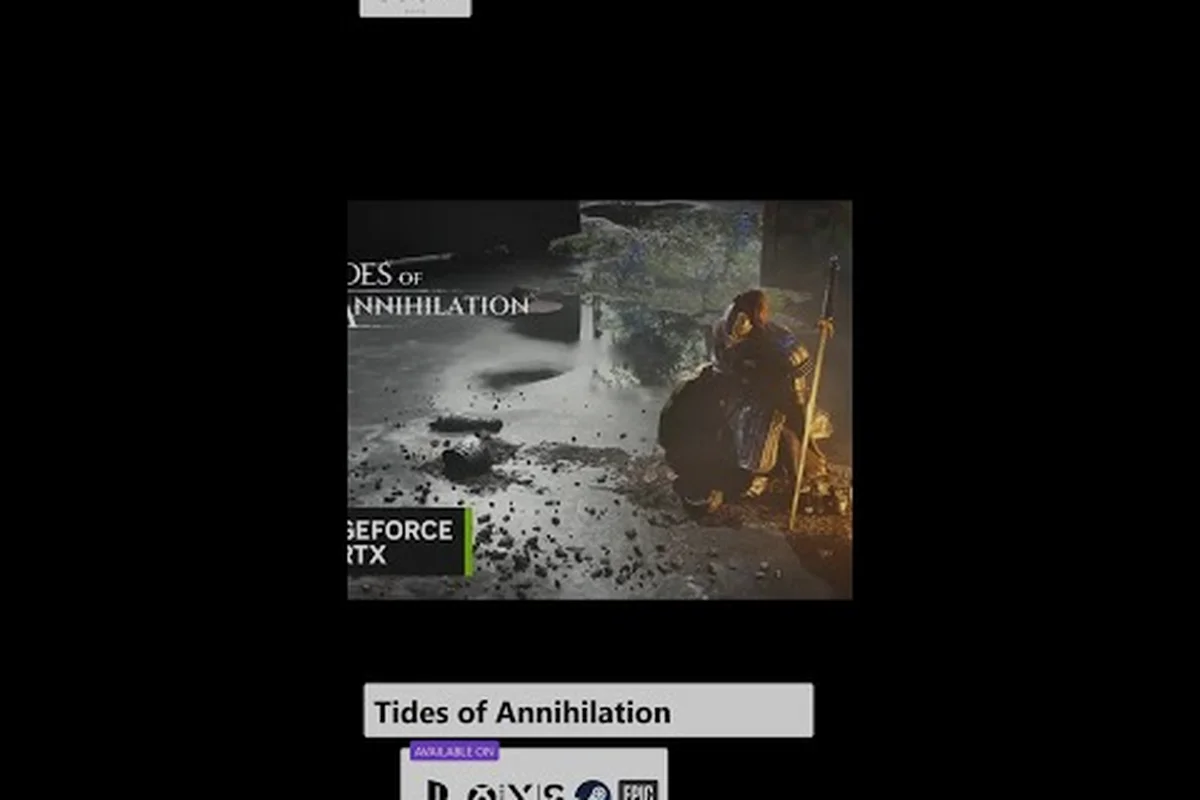
The Tides of Annihilation system requirements are the single most important thing to check before you commit to a preorder, because this Unreal Engine 5 title from Eclipse Glow Games promises the kind of visual fidelity that can crush older GPUs. Built with the full weight of Epic's latest engine and showcased with NVIDIA DLSS and ray tracing in official trailers, the game targets a shattered-London setting packed with colossal enemies and spectral knight summons that demand serious hardware. Whether you plan to play at 1080p on a mid-range rig or push 4K with path tracing enabled, knowing what the Tides of Annihilation minimum requirements and recommended specs look like will save you from a disappointing launch-day experience.
The official Tides of Annihilation website confirms the game is being developed for PC alongside PS5 and Xbox Series X|S, though the studio has not yet published final PC specs as of August 2026. That means we have to make educated estimates based on the tech stack, the gameplay footage shown at PlayStation's February 2025 reveal, and the Xbox Partner Preview deep-dive from November 2025. This guide breaks down what we expect from the Tides of Annihilation system requirements, explains how path tracing and NVIDIA technology will affect performance, and gives you a practical upgrade path so you can plan your build with confidence.
Estimating the Tides of Annihilation PC Requirements
Because Eclipse Glow Games has not released official PC specs, the community has been piecing together expectations from the game's Unreal Engine 5 foundation and the visual targets shown in trailers. The game was built with UE5's Nanite and Lumen systems, which means geometry detail and dynamic lighting are handled differently than in older engines. Nanite streams high-poly assets in real time, while Lumen provides software-based global illumination and reflections that can be upgraded to hardware ray tracing on compatible GPUs.
The developer deep-dive published on Xbox Wire by producer Kun Fu explained the Dual Frontline Battle System, where Gwendolyn summons spectral forms of the Knights of the Round Table and commands their attacks. That system means the CPU has to track multiple AI-controlled knights alongside the player character, which pushes processor requirements higher than a typical action game. Based on that workload and the UE5 rendering pipeline, here is our estimated breakdown:
| Component | Minimum (1080p / 30fps) | Recommended (1440p / 60fps) | High-End (4K / 60fps+) |
|---|---|---|---|
| CPU | Intel Core i5-8400 / AMD Ryzen 5 2600 | Intel Core i7-10700K / AMD Ryzen 5 5600X | Intel Core i7-12700K / AMD Ryzen 7 5800X3D |
| GPU | NVIDIA GTX 1660 Super / AMD RX 5600 XT | NVIDIA RTX 3070 / AMD RX 6800 | NVIDIA RTX 4080 / AMD RX 7900 XTX |
| RAM | 16 GB | 16 GB | 32 GB |
| Storage | 100 GB SSD | 100 GB NVMe SSD | 100 GB NVMe SSD |
| OS | Windows 10 64-bit | Windows 11 64-bit | Windows 11 64-bit |
The minimum requirements we estimate target 1080p at 30 frames per second with upscaling enabled, which should be achievable on a GTX 1660 Super or equivalent. The recommended requirements aim for 1440p at a stable 60fps, which is where the game's combat system really shines because the Dual Frontline mechanic demands responsive inputs. For 4K with ray tracing and path tracing enabled, you will want an RTX 4080-class card or better, especially since the game's particle effects and dynamic lighting are heavy on GPU resources.
How Unreal Engine 5 Shapes the Tides of Annihilation Specs
The choice of Unreal Engine 5 is the biggest factor driving the Tides of Annihilation system requirements, because UE5 introduces rendering features that simply did not exist in the previous generation of engines. Nanite virtualized geometry allows the developers to use film-quality assets without manual LOD management, which means the shattered London landmarks and colossal knights retain their detail at any distance. Lumen provides real-time global illumination that bounces light across the ruined cityscape, creating the moody atmosphere visible in every trailer.
According to Wikipedia's coverage of the game, Eclipse Glow Games is based in Chengdu, China, and this is the studio's debut title with investment from Tencent. The game has been in development for three years as of GDC 2025, which means the team has had time to optimize the UE5 pipeline for their specific vision. That optimization matters because UE5 games have a reputation for being demanding, but the actual performance depends heavily on how the developers configure Nanite and Lumen for their target platforms.
Understanding the Path Tracing Option
Path tracing is the most demanding rendering feature that the Tides of Annihilation system requirements will need to account for, because it replaces traditional rasterization with a physically accurate light simulation. NVIDIA has been pushing path tracing as the ultimate visual upgrade for UE5 games, and the Tides of Annihilation NVIDIA technology partnership suggests the game will support DLSS 4 with multi-frame generation. That combination allows players to enable path tracing at playable frame rates, but only on RTX 40-series and newer GPUs.
The path tracing implementation in UE5 works by tracing light paths through the entire scene for each pixel, which produces photorealistic reflections, shadows, and ambient occlusion. The cost is enormous — a path-traced scene can be 5-10 times more expensive to render than a rasterized one — which is why DLSS upscaling and frame generation become essential. If you want to experience the game with path tracing enabled, plan for an RTX 4070 Ti Super or better, and expect to use DLSS Quality mode to maintain 60fps at 1440p.
NVIDIA Technology and DLSS Integration
The Tides of Annihilation NVIDIA technology partnership means the game will likely launch with day-one DLSS support, which is excellent news for PC players because it dramatically lowers the effective hardware barrier. DLSS 4 with multi-frame generation can triple or quadruple frame rates in GPU-bound scenarios, which means a mid-range RTX 4060 could potentially deliver 60fps at 1440p with quality upscaling. The catch is that frame generation introduces slight input latency, which matters in a combat game where parry timing is critical.
For competitive play or the hardest boss encounters, you will want to prioritize native frame rate over frame generation. The game's combat system, as detailed in the beginner guide, relies on precise dodge and parry windows that become harder to read when frame generation adds latency. A good rule of thumb is to use DLSS Quality upscaling without frame generation for the base image, then enable frame generation only if you need extra headroom for 4K or path tracing.
Storage and Memory Considerations for Tides of Annihilation
Storage requirements for Tides of Annihilation are another factor that players need to plan for, because UE5 games with high-resolution textures and Nanite geometry assets tend to be large. The game's shattered London setting features multiple distinct districts, each with unique architecture, environmental storytelling, and enemy types, which means a substantial amount of texture and geometry data. Based on the scope shown in trailers and the technical demands of UE5, we estimate the game will require 100 GB of storage space at launch, with the possibility of additional day-one patches.
The type of storage matters almost as much as the capacity, because UE5 games stream assets from disk in real time. An NVMe SSD is strongly recommended because it provides the bandwidth needed to load Nanite geometry and high-resolution textures without hitches. The game's fast travel system and seamless transitions between combat encounters will benefit significantly from NVMe speeds, while a traditional hard drive could cause noticeable pop-in and longer load times.
| Storage Type | Load Time Estimate | Asset Streaming Quality | Recommendation |
|---|---|---|---|
| HDD (7200 RPM) | 60-90 seconds | Frequent pop-in | Not recommended |
| SATA SSD | 20-30 seconds | Minor pop-in | Playable |
| NVMe SSD | 5-10 seconds | Smooth streaming | Strongly recommended |
| PCIe 4.0 NVMe | 3-5 seconds | Optimal experience | Best choice |
The RAM requirements are also worth considering carefully, because UE5 games with Lumen global illumination can consume more memory than traditional engines. We estimate that 16 GB of RAM will be the minimum for 1080p gaming, but 32 GB is the safer choice for 1440p and above, especially if you keep background applications running while you play. Players who plan to enable path tracing should definitely consider 32 GB, because the light simulation data adds to the memory footprint.
Platform Comparison and the PS5 Pro Advantage
While this guide focuses on the Tides of Annihilation system requirements for PC, it is worth comparing the console experience because it gives PC players a performance baseline to aim for. The PlayStation Blog announcement confirmed that the game will feature a PS5 Pro Enhanced Mode that uses the Pro's additional GPU power and PSSR technology to achieve higher resolution, ray tracing, improved image fidelity, and smoother 60fps gameplay. That means the PS5 Pro is targeting roughly the same visual quality as a PC with an RTX 4070-class GPU.
The standard PS5 and Xbox Series X versions will likely target 1440p to 4K with dynamic resolution scaling and a 60fps performance mode, while the Series S will probably run at 1080p to 1440p with lower graphical settings. The PS5 Pro Enhanced Mode is the console experience that most closely matches the recommended PC specs, which gives you a useful reference point when deciding how much to invest in your build. If you want to see how the console versions compare in detail, the PS5 Pro enhanced analysis breaks down the resolution modes and performance targets.
| Platform | Resolution Target | Frame Rate | Key Features |
|---|---|---|---|
| PS5 | 1440p-4K dynamic | 30-60fps | Ray tracing in quality mode |
| PS5 Pro | 4K with PSSR | 60fps | Enhanced ray tracing, improved fidelity |
| Xbox Series X | 1440p-4K dynamic | 30-60fps | Ray tracing in quality mode |
| Xbox Series S | 1080p-1440p | 30-60fps | Reduced graphical settings |
| PC (Recommended) | 1440p-4K | 60fps+ | DLSS, path tracing, full settings |
The Xbox Series X performance is expected to be very close to the standard PS5, since both consoles share similar GPU capabilities. The Series S will be the weakest console version, and players on that platform should expect lower resolution and reduced effects quality. PC players with hardware above the recommended specs will have the best experience overall, because the game supports ultrawide monitors, uncapped frame rates, and the full range of NVIDIA features.
Building Your PC for Tides of Annihilation Launch
If you are planning to build or upgrade your PC for Tides of Annihilation, the smartest approach is to target the recommended requirements rather than the minimum, because the game's combat system benefits from higher frame rates. The Dual Frontline Battle System requires you to track both Gwendolyn and her summoned knights simultaneously, and a smooth 60fps makes it much easier to read enemy attack patterns and time your parries. The graphics settings optimization guide can help you squeeze the most performance out of your specific hardware once the game launches.
For a new build, we recommend pairing an AMD Ryzen 5 7600 or Intel Core i5-13600K with an NVIDIA RTX 4070 Super or AMD RX 7800 XT. This combination should comfortably handle 1440p at 60fps with high settings, and it gives you enough headroom for DLSS quality upscaling if you want to push toward 4K. If you are on a tighter budget, a Ryzen 5 5600 with an RTX 3060 Ti will still deliver a solid 1080p experience, though you may need to lower some settings to maintain 60fps in the most demanding boss fights.
Prioritizing GPU Over CPU
For this game specifically, the GPU matters more than the CPU because the visual fidelity is the main performance bottleneck. The CPU requirements are moderate — a six-core processor from the last few years will handle the knight AI and physics calculations without issue — but the GPU needs to render the dense UE5 scenes with Nanite geometry and Lumen lighting. If you have to choose between upgrading your graphics card or your processor, put your money into the GPU first.
That said, do not completely neglect the CPU, because the Dual Frontline system does add processing overhead. Players with very old four-core processors like the i5-8400 might see frame drops in crowded combat scenarios where multiple knights are active alongside numerous enemies. The Ryzen 5 5600 or i5-12400F represent the sweet spot for budget builds, offering enough single-thread performance for the game's physics and AI while leaving room in the budget for a better GPU.
Planning for Day-One Patches and Driver Updates
The Tides of Annihilation system requirements will likely evolve after launch, because UE5 games typically receive performance patches and driver optimizations in the first few weeks. NVIDIA and AMD usually release game-ready drivers on launch day that can improve performance by 5-15 percent, so make sure you update your drivers before your first session. The community on r/TidesOfAnnihilation has been tracking the game's development closely, and players are already sharing their hardware expectations and benchmark predictions.
It is also worth noting that the game's storage requirements might increase with post-launch content updates. The developers have not announced any DLC plans, but the Arthurian legend setting offers plenty of material for expansion packs featuring additional knights or story chapters. Keeping at least 20 GB of free space beyond the base install is a smart precaution, and it gives you room for screenshot captures and video recordings if you plan to share your boss fights.
Frequently Asked Questions
What are the Tides of Annihilation minimum requirements?
As of now, Eclipse Glow Games hasn't published official minimum PC specs for Tides of Annihilation. Since it's built on Unreal Engine 5 with a shattered-London setting and the Dual Frontline Battle System, expect a modern quad-core CPU and a ray-tracing-capable GPU like an RTX 2060 as a baseline. We'll update this page once the studio confirms final requirements.
Will Tides of Annihilation support path tracing on PC?
Yes, the game's NVIDIA technology partnership strongly suggests path tracing support will be included, likely through a high-end graphics preset. Path tracing requires an RTX 40-series GPU or newer, and you will need DLSS enabled to maintain playable frame rates at 1440p or 4K resolution.
How much storage space does Tides of Annihilation need?
We estimate the game will require approximately 100 GB of storage space, with an NVMe SSD strongly recommended for optimal asset streaming. The game uses UE5's Nanite geometry system, which benefits significantly from the high read speeds of NVMe drives to prevent texture pop-in.
Is the PS5 Pro version comparable to high-end PC specs?
The PS5 Pro Enhanced Mode targets 4K resolution with PSSR upscaling and 60fps gameplay, which is roughly equivalent to a PC with an RTX 4070-class GPU. The PC version can exceed this with path tracing, ultrawide support, and higher frame rates on more powerful hardware.
When will official system requirements be announced?
Eclipse Glow Games hasn’t confirmed official specs as of August 2026, but expect the reveal near launch, likely alongside a demo or open beta. Watch for announcements tied to the PS5 Pro Enhanced Mode and Unreal Engine 5 details, since those will heavily inform the PC requirements. Wishlist on Steam to get notified immediately.